

About
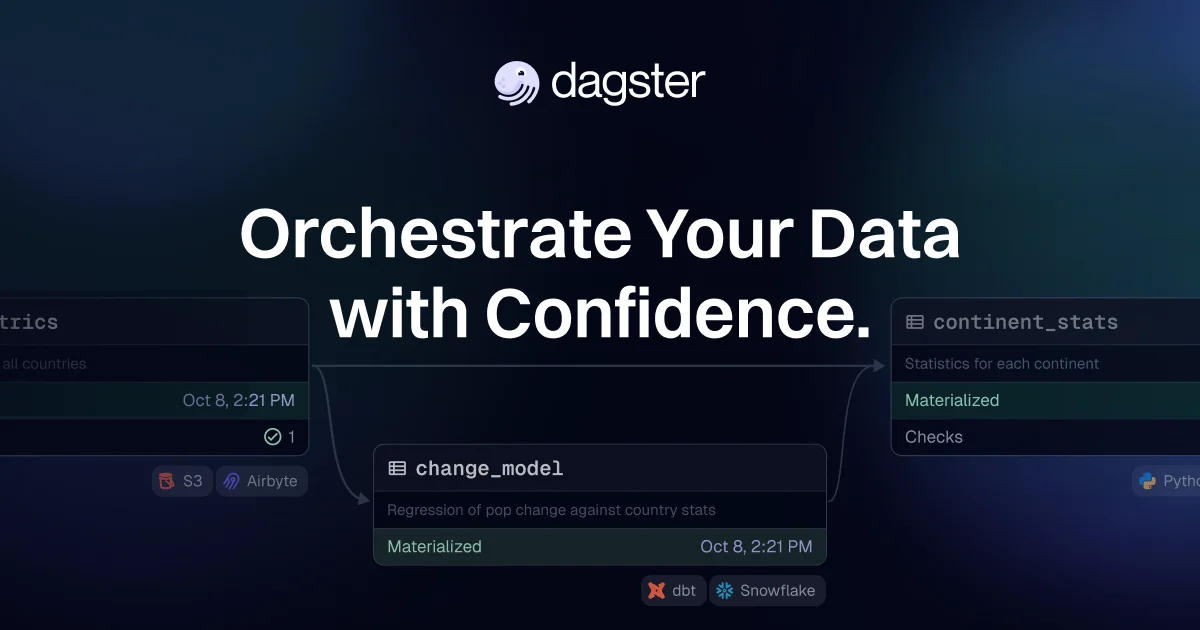
Dagster is a powerful, open-source data orchestration platform designed for modern data and AI teams. It serves as a unified control plane for building, scheduling, monitoring, and scaling data pipelines — from simple ETL/ELT flows to complex AI and machine learning operations. With Dagster, teams can orchestrate dbt, Databricks, or Python-based transformations, move data from SaaS apps and APIs into warehouses like Snowflake or BigQuery, and streamline ML model training and experiment tracking. Dagster's integrated observability layer provides real-time health metrics, automatic data lineage, and intelligent Slack alerts so teams can catch and resolve issues before they impact stakeholders. Its built-in data catalog auto-generates documentation and tracks ownership, making it easy for anyone to discover and understand datasets. A standout feature is Compass, Dagster's AI data analyst for Slack, which lets business stakeholders ask questions and receive instant, trusted answers drawn directly from warehouse data — governed by the data team through GitOps. On the enterprise side, Dagster offers SSO, RBAC, SCIM provisioning, SOC 2 Type II and HIPAA compliance, flexible cloud or self-hosted deployment across North American and European regions, and full audit logging. Dagster is ideal for data engineers, analytics engineers, and ML teams building scalable, trustworthy data platforms.
Key Features
- End-to-End Data Orchestration: Build, schedule, and monitor ETL/ELT pipelines, dbt transformations, and Databricks workloads in a single unified platform.
- AI & ML Workflow Management: Accelerate ML development with pipelines for data prep, model training, and experiment tracking, all orchestrated from one control plane.
- Data Catalog & Lineage: Auto-generated documentation, clear data ownership, and end-to-end lineage let teams discover and trust their datasets effortlessly.
- Compass AI Data Analyst: An AI analyst embedded in Slack that answers business questions with real warehouse data, governed by the data team via GitOps.
- Intelligent Monitoring & Alerting: Real-time health metrics, freshness tracking, cost insights, and AI-powered debugging keep pipelines healthy and stakeholders confident.
Use Cases
- Building and scheduling ETL/ELT pipelines that move data from SaaS applications and APIs into cloud data warehouses like Snowflake or BigQuery.
- Orchestrating dbt transformations and Databricks jobs to produce clean, modeled data for analytics and business intelligence dashboards.
- Managing end-to-end AI and ML workflows, including data preparation, feature engineering, model training, and experiment tracking.
- Enabling business stakeholders to get instant, self-serve data insights directly in Slack using the Compass AI analyst without relying on data team bandwidth.
- Implementing enterprise data governance with lineage tracking, ownership documentation, real-time monitoring, and compliance-ready audit logs.
Pros
- Unified Platform for Data & AI: Combines orchestration, observability, cataloging, and AI insights in one place, reducing tool sprawl and context-switching for data teams.
- Open-Source Core with Enterprise Options: The open-source engine gives teams flexibility and transparency, while Dagster+ provides a managed cloud with enterprise-grade security and compliance.
- First-Class Observability: Built-in lineage tracking, real-time health metrics, and Slack-native alerting make it easy to catch and resolve data issues proactively.
- Strong Enterprise Compliance: SOC 2 Type II, HIPAA alignment, SSO, RBAC, and SCIM provisioning make Dagster suitable for regulated industries and large organizations.
Cons
- Steep Learning Curve: Dagster's asset-centric model and declarative approach can require significant onboarding time compared to simpler workflow tools.
- Dagster+ Costs at Scale: The managed Dagster+ cloud offering can become costly for large teams or high-volume pipelines relative to self-hosting the open-source version.
- Infrastructure Overhead for Self-Hosting: Running Dagster open source requires managing your own deployment, which demands DevOps expertise and ongoing maintenance.
Frequently Asked Questions
Is Dagster open source?
Yes, Dagster's core orchestration engine is open source and available on GitHub. Dagster+ is the managed cloud offering with additional enterprise features and a paid subscription model.
What is Dagster Compass?
Compass is Dagster's AI data analyst for Slack. It lets business stakeholders ask questions in plain language and receive instant, trustworthy answers pulled directly from your data warehouse, with governance controlled by the data team through GitOps.
How does Dagster compare to Airflow?
Dagster uses an asset-centric, software-defined data model rather than task-centric DAGs, providing richer lineage, better observability, and a more developer-friendly experience. It also has a built-in catalog and modern UI compared to Airflow's older paradigm.
What deployment options does Dagster offer?
Dagster can be self-hosted on your own cloud infrastructure (AWS, GCP, Azure, Kubernetes) or run as a fully managed service through Dagster+, with support for both North American and European regions.
What integrations does Dagster support?
Dagster integrates with major data tools including Snowflake, BigQuery, Databricks, dbt, Spark, Airbyte, Fivetran, Slack, and many others, covering the full modern data stack.