

About
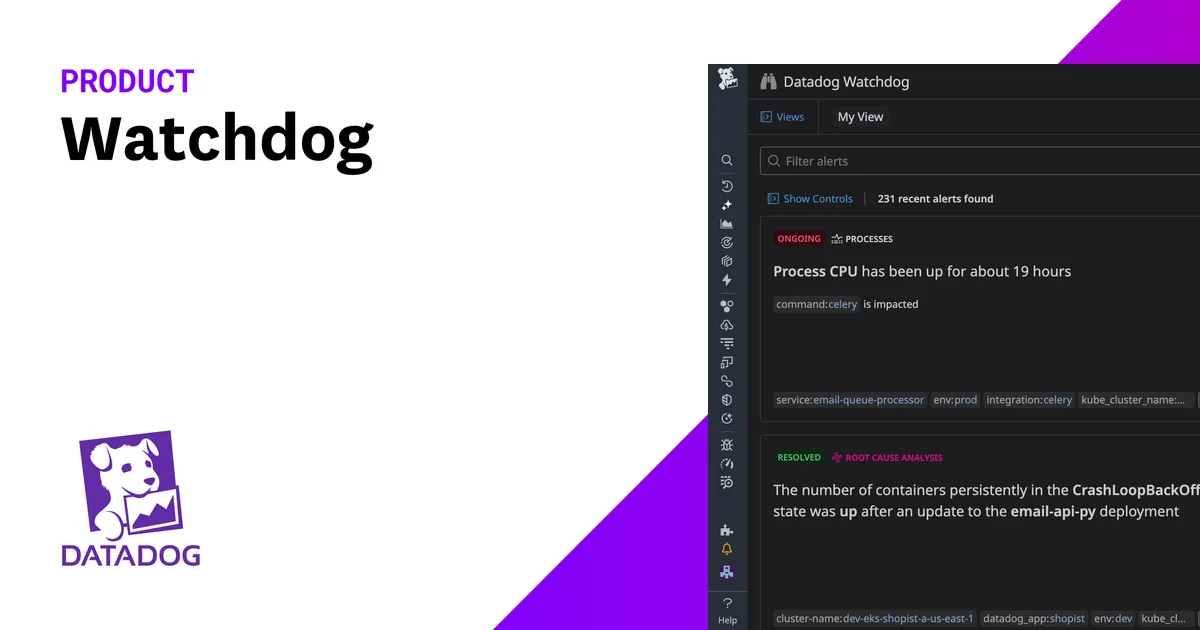
Datadog Watchdog is an AI-driven observability engine built into the Datadog platform that proactively surfaces performance degradations, anomalies, and potential outages across your full technology stack. Unlike traditional alerting that requires manually configured thresholds, Watchdog uses machine learning to establish baselines and automatically flag deviations in infrastructure metrics, application performance, logs, error rates, and latency. Watchdog integrates seamlessly with Datadog's broader suite — including APM, Infrastructure Monitoring, Log Management, RUM, Synthetics, and more — providing a unified view of correlated issues. When it detects an anomaly, Watchdog surfaces contextual insights that help engineers quickly identify root causes, reducing mean time to resolution (MTTR). Key capabilities include proactive alerting on service errors and latency spikes, automatic correlation of related signals across services, database and cloud infrastructure monitoring, and AI-powered root cause analysis. Watchdog also powers the Watchdog Alerts feature, which continuously scans your environment for unusual patterns and presents a prioritized feed of issues requiring attention. Designed for DevOps teams, SREs, and platform engineers at businesses of all sizes, Watchdog eliminates alert fatigue by intelligently filtering noise and surfacing only the most actionable signals. It supports complex cloud-native and microservices environments including Kubernetes, serverless, and multi-cloud deployments, making it an essential AI layer for modern engineering teams managing large-scale distributed systems.
Key Features
- Automatic Anomaly Detection: Uses ML to establish dynamic baselines and flag deviations in performance metrics, error rates, and latency — without requiring manual alert configuration.
- Cross-Signal Correlation: Automatically correlates related anomalies across infrastructure, APM, logs, and RUM to surface root causes faster and reduce investigation time.
- Proactive Watchdog Alerts Feed: Continuously scans your environment and presents a prioritized, noise-filtered feed of actionable issues for engineering teams to act on.
- Full-Stack Coverage: Monitors the complete stack including cloud infrastructure, Kubernetes, databases, serverless, applications, and LLM-based AI workloads.
- AI Root Cause Analysis: Provides contextual insights and correlations to help teams quickly identify the underlying cause of incidents and reduce MTTR.
Use Cases
- Automatically detecting a sudden spike in API error rates across microservices before users report issues, with correlated root cause insights pointing to a recent deployment.
- Monitoring Kubernetes cluster health and surfacing infrastructure anomalies such as memory pressure or pod restarts without requiring manual alert configuration.
- Identifying latency degradation in database queries by correlating APM traces with infrastructure metrics, helping DBAs pinpoint bottlenecks quickly.
- Proactively alerting SRE teams to unusual patterns in LLM-based AI application performance, such as increased token latency or model error rates.
- Reducing alert fatigue for DevOps teams by filtering noisy signals and presenting a prioritized feed of only the most impactful issues requiring action.
Pros
- No Manual Threshold Tuning: Watchdog learns your system's normal behavior automatically, eliminating the burden of setting and maintaining hundreds of alert thresholds.
- Deep Platform Integration: Natively integrated with the full Datadog platform — APM, Logs, Infrastructure, RUM, Synthetics — enabling holistic, correlated observability.
- Reduces Alert Fatigue: AI filtering surfaces only the most relevant and impactful signals, helping teams focus on real problems rather than noise.
- Broad Stack Support: Covers modern cloud-native environments including Kubernetes, multi-cloud, serverless, and distributed microservices architectures.
Cons
- Requires Datadog Subscription: Watchdog is not a standalone product — it's part of the Datadog platform, which can be costly for smaller teams or startups.
- Vendor Lock-In: Deep integration with the Datadog ecosystem means teams heavily dependent on Watchdog face significant migration effort if switching platforms.
- Learning Curve for Full Value: Extracting maximum value from Watchdog's insights requires familiarity with Datadog's broader toolset and observability concepts.
Frequently Asked Questions
What is Datadog Watchdog?
Datadog Watchdog is an AI engine built into the Datadog platform that automatically detects anomalies and performance issues across infrastructure, applications, logs, and more — without requiring manually configured alert thresholds.
How does Watchdog detect anomalies?
Watchdog uses machine learning to continuously learn the normal behavior of your services and infrastructure. It then flags statistically significant deviations from those baselines as potential issues requiring attention.
Is Watchdog a standalone product?
No. Watchdog is an integrated capability within the Datadog observability platform. You need a Datadog subscription to use it, and it works across Datadog's APM, Infrastructure, Logs, RUM, and other products.
What environments does Watchdog support?
Watchdog supports a wide range of environments including Kubernetes, cloud infrastructure (AWS, Azure, GCP), serverless, databases, microservices, and AI/LLM workloads monitored through Datadog's LLM Observability module.
How does Watchdog help reduce MTTR?
Watchdog automatically correlates related anomalies across different signals (metrics, traces, logs) and surfaces root cause insights, enabling engineering teams to identify and resolve issues significantly faster than manual investigation.