

About
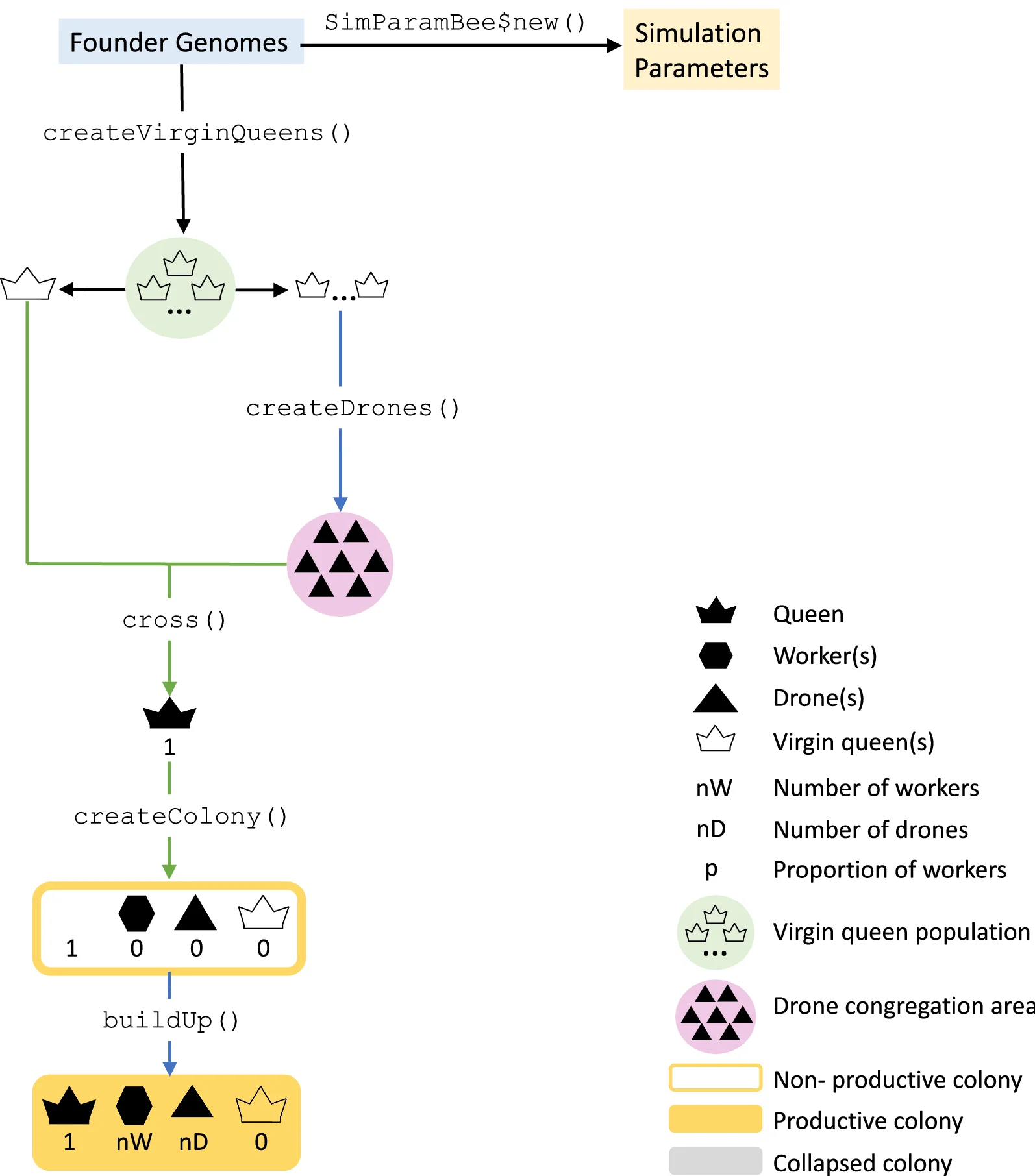
SIMplyBee is a holistic stochastic simulator for honeybee populations and breeding programs, implemented as an R package freely available on CRAN. It builds upon AlphaSimR — a powerful simulator for individuals with genomes and quantitative genetic values — and extends it with honeybee-specific classes and functions. Key additions include SimParamBee for global simulation parameters, Colony and MultiColony classes for managing single or multiple honeybee colonies, and specialized functions covering honeybee genome simulation, haplodiploid inheritance, social colony organisation, complementary sex determination, polyandry, colony life events, and both individual- and colony-level quantitative genetics. Researchers can use SIMplyBee to rapidly and cost-effectively test different honeybee breeding strategies, conservation approaches, and genetic management programs without the need for expensive field trials. The package supports custom user-defined functions to model complex within-colony interactions, making it adaptable to a wide range of research questions. Genomic data export, phenotype simulation, and spatial mating functions are also supported. SIMplyBee is aimed at honeybee geneticists, animal breeders, conservation biologists, and academic researchers who require a rigorous, flexible platform for in-silico honeybee population studies. Comprehensive documentation and tutorials are available at SIMplyBee.info.
Key Features
- Honeybee-Specific Genome Simulation: Simulates the unique honeybee genome including haplodiploid inheritance and complementary sex determination at the individual level.
- Colony and MultiColony Classes: Provides dedicated Colony and MultiColony data structures to manage single or large populations of honeybee colonies simultaneously.
- Colony Event Modelling: Supports simulation of key colony life events such as swarming, supersedure, and seasonal cycles that affect colony dynamics and genetics.
- Individual- and Colony-Level Quantitative Genetics: Allows computation of breeding values at both the individual bee and whole-colony level, with user-defined functions to model within-colony interactions.
- Polyandry and Mating Simulation: Models queen polyandry and drone congregation area mating, with support for spatial awareness and controlled mating scenarios.
Use Cases
- Testing and comparing alternative honeybee selective breeding schemes before costly field implementation
- Evaluating genetic conservation strategies to maintain diversity in endangered or declining honeybee populations
- Studying the effects of polyandry and drone population composition on colony genetic structure
- Simulating genomic selection programs in honeybees to assess expected genetic gain over generations
- Academic teaching and research on haplodiploid genetics, social insect biology, and quantitative genetics
Pros
- Completely Free and Open Source: Available on CRAN under an open licence, making it accessible to researchers and institutions worldwide at no cost.
- Biologically Comprehensive: Uniquely addresses honeybee-specific biology (haplodiploidy, polyandry, sex determination) that general animal breeding simulators ignore.
- Extensible and Customisable: User-defined functions for colony-level trait aggregation allow modelling of any interaction structure within or between colonies.
- Well-Documented with Active Community: Extensive documentation at SIMplyBee.info and peer-reviewed publication invite community contributions and ongoing development.
Cons
- Requires R Programming Knowledge: Users must be comfortable writing R code; there is no graphical user interface, creating a barrier for non-programmers.
- Computationally Intensive for Large Simulations: Genome-level stochastic simulations across many colonies can demand significant memory and CPU, limiting scale on standard hardware.
- Specialised Use Case: Designed exclusively for honeybee research; not applicable to other livestock or pollinator species without major modification.
Frequently Asked Questions
How do I install SIMplyBee?
SIMplyBee can be installed from CRAN in R using install.packages('SIMplyBee'). Full installation instructions and documentation are available at http://www.SIMplyBee.info.
What does SIMplyBee build upon?
SIMplyBee extends AlphaSimR, a stochastic simulator for populations with individual genomes and quantitative genetic values, by adding honeybee-specific classes and functions.
Can SIMplyBee simulate conservation programs as well as breeding programs?
Yes. SIMplyBee is designed to test both selective breeding strategies and genetic conservation approaches, helping evaluate their effect on future genetic gain and genetic variability.
Is SIMplyBee suitable for researchers with no prior simulation experience?
Researchers familiar with R can get started using the tutorials and vignettes at SIMplyBee.info. Some background in quantitative genetics and honeybee biology is helpful for interpreting results.
What are the planned future developments for SIMplyBee?
The development roadmap includes improving honeybee genome simulation accuracy, optimising computational performance, and adding spatial awareness to mating and phenotype simulation functions.