
About
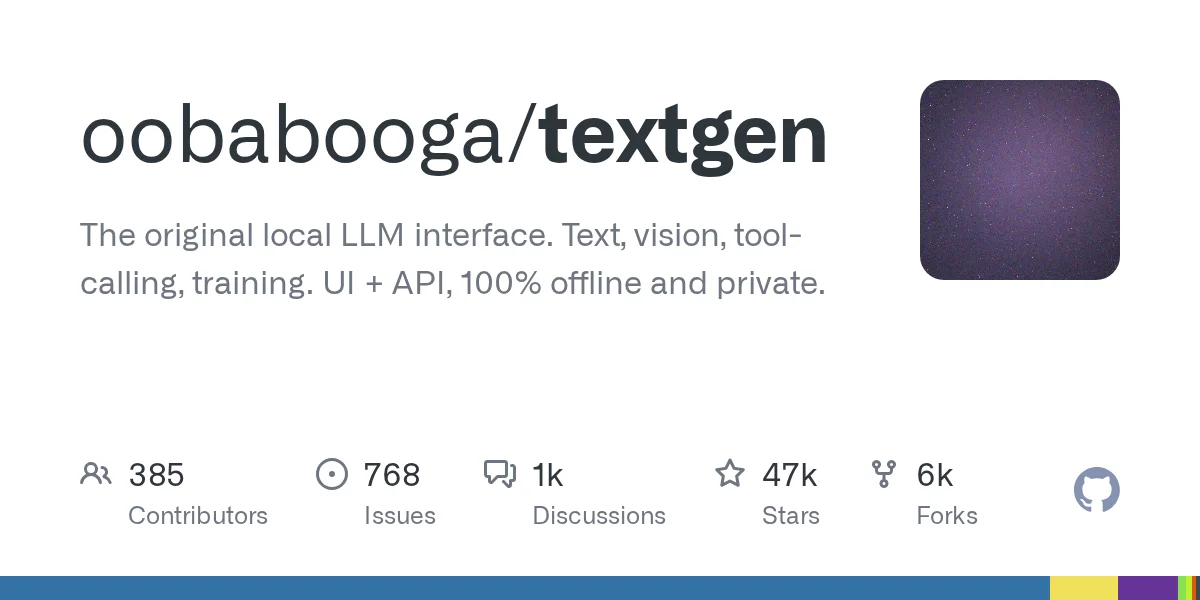
Text Generation WebUI, developed by oobabooga, is the most popular open-source local LLM inference interface available. Designed for privacy-conscious users, researchers, and developers, it allows you to run a wide variety of large language models entirely on your own machine — no cloud, no subscriptions, no data leaving your system. The project supports a broad ecosystem of model formats and backends, including Transformers, llama.cpp, ExLlamaV2, AutoGPTQ, and more. Its intuitive Gradio-based web interface makes it easy to load models, configure generation parameters, and interact via chat or notebook modes. An OpenAI-compatible API server lets developers integrate it into existing applications with minimal friction. Beyond basic text generation, it supports vision/multimodal models, tool-calling (function calling), and LoRA-based training and fine-tuning workflows. Extensions further expand capabilities, enabling integrations with image generation, speech synthesis, translation, and more. Text Generation WebUI runs natively on Linux, macOS, and Windows, with Docker support for containerized deployments. It is released under the AGPL-3.0 license, making it fully open source and community-driven. It is ideal for AI researchers, developers building LLM-powered apps, privacy-focused users, and hobbyists who want to experiment with state-of-the-art language models without relying on commercial APIs.
Key Features
- Local & Fully Private: Run LLMs entirely on your own hardware with no internet connection required — your data never leaves your machine.
- Multi-Backend Model Support: Compatible with Transformers, llama.cpp, ExLlamaV2, AutoGPTQ, and more, supporting a wide range of model formats and quantizations.
- OpenAI-Compatible API: Built-in API server that mirrors the OpenAI API spec, making it easy to integrate with existing tools and applications.
- Vision, Tool-Calling & Training: Supports multimodal vision models, function/tool-calling, and LoRA-based fine-tuning workflows in a single interface.
- Extensible via Plugins: A rich extensions system enables integrations with image generation, text-to-speech, translation, character personas, and more.
Use Cases
- Running open-source LLMs like LLaMA, Mistral, or Falcon privately on local hardware without sending data to any cloud provider.
- Developers building and testing LLM-powered applications using the OpenAI-compatible local API as a drop-in replacement for cloud APIs.
- Researchers and data scientists fine-tuning open-source language models using LoRA adapters directly in the interface.
- Privacy-conscious individuals who want to use AI chat assistants for sensitive topics without any external data exposure.
- Hobbyists and enthusiasts experimenting with the latest open-source multimodal and vision-language models in an accessible UI.
Pros
- Completely Free & Open Source: Released under AGPL-3.0 with no usage fees, subscriptions, or rate limits — you own your entire inference stack.
- Broad Model Compatibility: Supports virtually every major open-source LLM format and backend, giving users maximum flexibility in model choice.
- Active Community & Ecosystem: With 46,000+ GitHub stars and thousands of forks, the project has a large, active community continuously contributing extensions and improvements.
- Cross-Platform Support: Runs natively on Linux, macOS, and Windows with one-click installer scripts, plus Docker support for containerized deployments.
Cons
- Requires Capable Local Hardware: Running large models demands significant GPU VRAM and system RAM, which may be a barrier for users without high-end hardware.
- Setup Complexity for Beginners: Initial configuration of drivers, backends, and model downloads can be technically challenging for non-developers.
- No Managed Hosting: As a self-hosted solution, users are responsible for all infrastructure, updates, and troubleshooting without a managed cloud option.
Frequently Asked Questions
What is Text Generation WebUI?
Text Generation WebUI is an open-source, self-hosted web interface for running large language models (LLMs) locally on your own computer. It supports text generation, vision/multimodal models, tool-calling, and model fine-tuning, all with 100% privacy and no cloud dependency.
Which operating systems does it support?
It supports Linux, macOS, and Windows natively via startup scripts, and is also available as a Docker container for more advanced deployments.
What model formats and backends are supported?
It supports a wide range of backends including Transformers (HuggingFace), llama.cpp, ExLlamaV2, AutoGPTQ, and GPTQ-for-LLaMa, covering most popular open-source model formats.
Does it have an API I can use in my own apps?
Yes. Text Generation WebUI includes an OpenAI-compatible API server, allowing you to point existing applications that use the OpenAI SDK to your local instance with minimal code changes.
Is it really free to use?
Yes. It is fully open source under the AGPL-3.0 license with no usage fees, paywalls, or token limits. The only costs are your own hardware and electricity.