
About
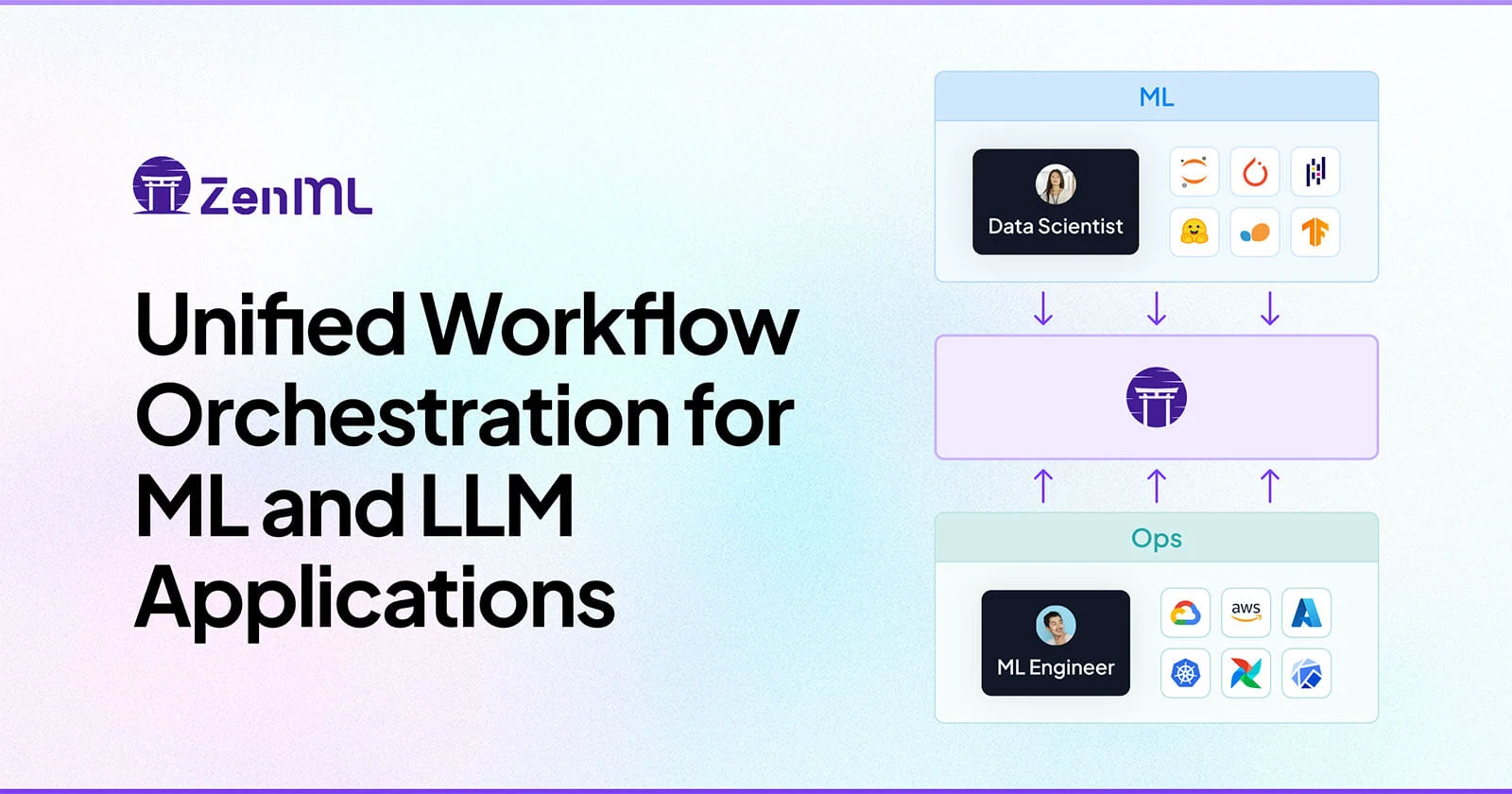
ZenML is an open-source AI Control Plane designed to bridge the gap between ML experimentation and production deployment. It provides a single unified layer for orchestrating everything from classical Scikit-learn training jobs to complex LangGraph agent loops, all within one consistent DAG-based framework. At its core, ZenML automatically tracks code, environments, and data artifacts at every pipeline step — making it trivial to reproduce experiments, diff library changes, and roll back to working states when model updates break production. Infrastructure abstraction lets teams define hardware requirements in Python and have ZenML handle Dockerization, GPU provisioning, and pod scaling on Kubernetes or Slurm without writing YAML. ZenML's smart caching and deduplication engine prevents redundant compute costs by skipping already-executed training epochs and expensive LLM tool calls, dramatically reducing latency and API spend on evaluation pipelines. The governance layer centralizes API key and credential management to prevent leaks, enforces RBAC, and turns black-box agent behavior into observable, auditable pipelines. Trusted by companies like JetBrains and Adeo Leroy Merlin, ZenML supports both ML and GenAI use cases including fine-tuning LLMs, productionalizing RAG applications, and running agent evals. It is available as open source (6,200+ GitHub stars) and as ZenML Pro, a managed control plane offering additional enterprise features.
Key Features
- Unified Workflow Orchestration: Orchestrate Scikit-learn training jobs and complex LangGraph agent loops in a single unified DAG framework, with built-in state management, data passing, and termination control.
- Artifact & Environment Versioning: Automatically snapshots code, Pydantic versions, and container state for every pipeline step, enabling instant diffs and rollbacks when library updates break models or agents.
- Infrastructure Abstraction: Define hardware requirements in Python and let ZenML handle Dockerization, GPU provisioning, and pod scaling on Kubernetes or Slurm — no YAML required.
- Smart Caching & Deduplication: Skips redundant training epochs and expensive LLM tool calls using native caching, drastically reducing latency and API costs in evaluation pipelines and batch jobs.
- Governance & Security: Centralizes API key and credential management, enforces RBAC policies, and transforms opaque agent behavior into observable, auditable pipeline steps.
Use Cases
- Building and deploying end-to-end ML training pipelines with automatic versioning and reproducibility across cloud environments.
- Productionalizing RAG (Retrieval-Augmented Generation) applications with orchestrated ingestion, retrieval, and evaluation pipelines.
- Fine-tuning and evaluating large language models with cost-optimized caching and full lineage tracking of training artifacts.
- Running LLM agent evals and LangGraph-based agent workflows with observable, auditable pipeline steps and centralized credential management.
- Standardizing MLOps practices across enterprise data science teams with RBAC, shared reusable components, and a unified control plane.
Pros
- Truly Unified ML + LLM Platform: Handles both classical ML training pipelines and modern GenAI/agent workflows within a single framework, eliminating the need for separate tooling stacks.
- Open Source with Strong Community: 6,200+ GitHub stars and an active Slack community, with a full-featured open-source tier that provides real production value without requiring a paid plan.
- Infrastructure Agnostic: Runs seamlessly from a local laptop to multi-cloud Kubernetes clusters, giving teams full flexibility without vendor lock-in.
- Cost Reduction Through Caching: Native caching prevents redundant compute and LLM API calls, directly lowering cloud bills on large-scale training and evaluation workloads.
Cons
- Steeper Learning Curve for Complex Deployments: Setting up integrations with Kubernetes, Slurm, or cloud backends requires ML infrastructure knowledge that may be challenging for smaller or less DevOps-experienced teams.
- Advanced Features Locked Behind Pro Tier: Enterprise governance, managed control plane, and certain collaboration features require a paid ZenML Pro subscription.
- Python-Centric Ecosystem: ZenML is heavily Python-focused, which may limit adoption for teams working in other languages or those preferring low-code/no-code workflow tools.
Frequently Asked Questions
What is ZenML and what problem does it solve?
ZenML is an open-source AI Control Plane that provides a unified layer for orchestrating, versioning, and governing both ML training pipelines and LLM/agent workflows. It solves the problem of glue-coding disparate tools together and ensures reproducibility, visibility, and scalability from local development to Kubernetes.
Is ZenML free to use?
Yes, ZenML has a fully functional open-source version available on GitHub with 6,200+ stars. A paid ZenML Pro tier is also available, offering a managed control plane with additional enterprise features like advanced governance and RBAC.
Does ZenML support LLM and GenAI workflows?
Absolutely. ZenML is designed to handle LLMOps use cases including fine-tuning large language models, productionalizing RAG applications, running agent evaluations, and orchestrating LangGraph-based agent loops alongside traditional ML pipelines.
What infrastructure does ZenML support?
ZenML supports a wide range of infrastructure backends including local environments, Kubernetes, Slurm, and major cloud providers. It abstracts the infrastructure details so teams can define compute requirements in Python without writing custom YAML or cloud-specific configuration.
How does ZenML help with reproducibility?
ZenML automatically snapshots the exact code, library versions (including Pydantic models), and container state for every step of every pipeline run. If a dependency update breaks your model or agent, you can inspect the diff between runs and roll back to a known-working artifact instantly.