
About
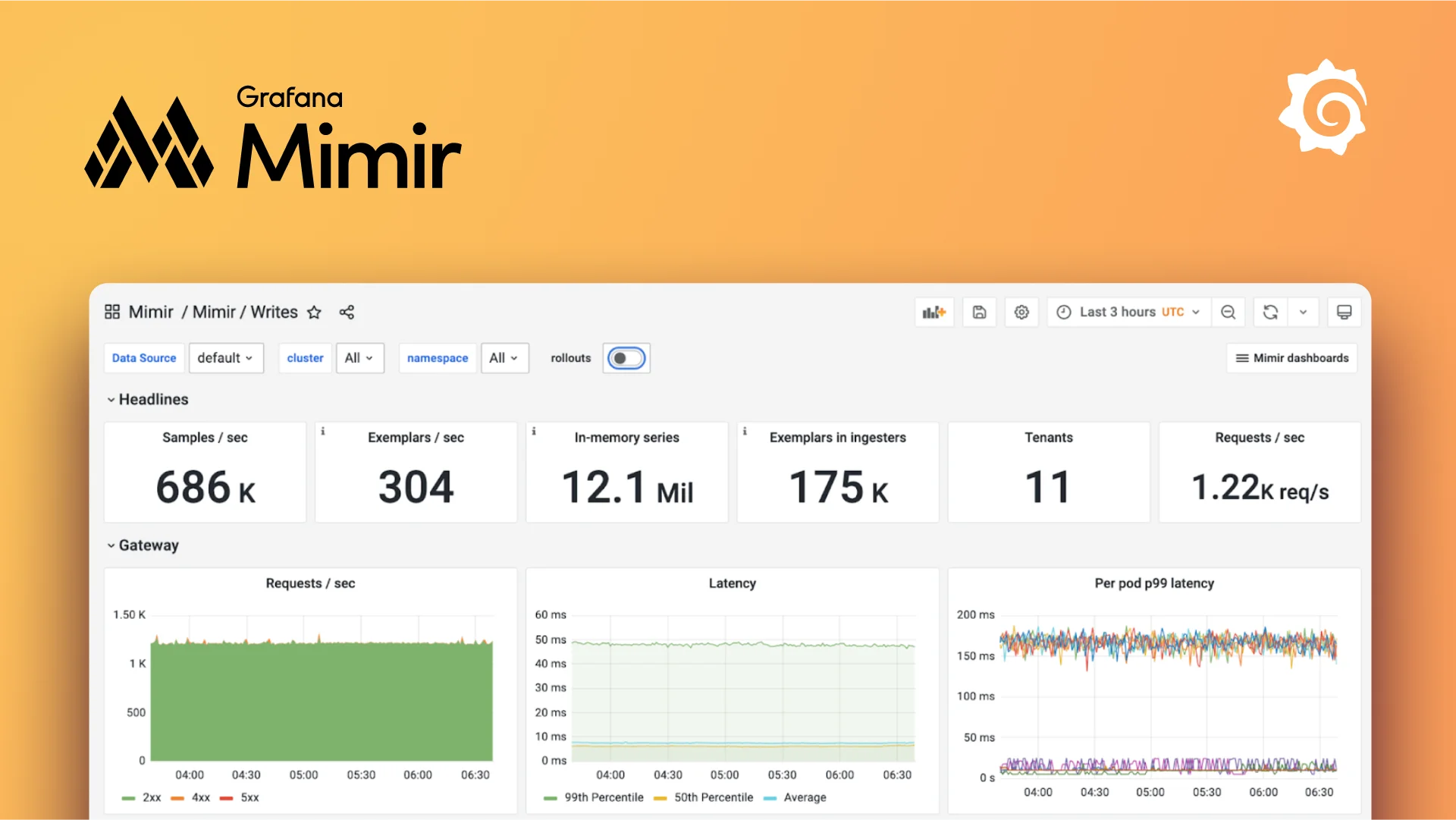
Grafana Mimir is an open source, horizontally scalable, highly available, multi-tenant time series database (TSDB) for long-term Prometheus metrics storage. Originally developed by Grafana Labs and publicly announced in 2022, Mimir builds on lessons learned operating Grafana Enterprise Metrics and Grafana Cloud Metrics at massive scale, as well as contributions to the Cortex project. Mimir is 100% Prometheus compatible, supporting remote write, PromQL queries, and alerting rules out of the box. Its horizontally scalable architecture allows teams to grow capacity simply by adding new nodes — no manual sharding, rebalancing, or replication configuration required. The built-in sharded query engine and compactor deliver blazing fast query performance and have been validated at over 1 billion active time series. For storage, Mimir supports durable, cost-effective object storage backends including Amazon S3, Google Cloud Storage, Azure Blob Storage, and OpenStack Swift. Advanced multi-tenancy and tenant federation are built in, making Mimir suitable for organizations serving multiple internal teams or external customers from a single cluster. Beyond Prometheus, Mimir can ingest metrics from InfluxDB, OpenTelemetry, Graphite, and Datadog-compatible sources. Visualization and alerting integrate naturally with Grafana dashboards. Released under the AGPLv3 license, Mimir is a production-grade choice for DevOps teams, SREs, and platform engineering organizations that demand reliable, long-term observability infrastructure at scale.
Key Features
- 100% Prometheus Compatible: Supports Prometheus remote write, PromQL queries, and alerting rules without any changes to existing Prometheus-based setups.
- Horizontal Scalability to 1B+ Series: Clustered, sharded architecture scales seamlessly by adding nodes — validated at over 1 billion active time series with no manual rebalancing.
- Durable Multi-Cloud Object Storage: Stores metrics durably on Amazon S3, Google Cloud Storage, Azure Blob Storage, or OpenStack Swift for cost-effective long-term retention.
- Advanced Multi-Tenancy & Isolation: Native multi-tenant architecture with tenant federation enables secure isolation for multiple teams or customers from a single Mimir cluster.
- Broad Metrics Ingestion Compatibility: Accepts metrics from Prometheus, Grafana Agent, InfluxDB, OpenTelemetry, Graphite, and Datadog-compatible sources.
Use Cases
- Storing and querying Prometheus metrics long-term across large distributed infrastructure with billions of active series.
- Building a centralized, multi-tenant observability platform for internal engineering teams or external SaaS customers.
- Replacing Prometheus' local storage with a scalable, highly available backend to eliminate single points of failure.
- Aggregating metrics from heterogeneous sources (OpenTelemetry, InfluxDB, Graphite) into a unified Prometheus-compatible backend.
- Running production-grade metrics infrastructure in regulated or compliance-sensitive environments using a self-managed, open source stack.
Pros
- Truly Open Source (AGPLv3): Fully open source with an active community, allowing teams to self-host without vendor lock-in and contribute to the project.
- Proven at Massive Scale: Battle-tested by Grafana Labs running Grafana Cloud Metrics at scale, with documented performance up to 1 billion active series.
- Zero-Friction Scaling: Adding capacity is as simple as adding nodes; Mimir handles clustering, replication, and rebalancing automatically.
- Native Grafana Integration: First-class support in Grafana for dashboards, alerting, and recording rules makes the observability stack cohesive and familiar.
Cons
- Significant Operational Complexity: Self-managing a Mimir cluster at scale requires deep expertise in distributed systems, object storage configuration, and Kubernetes operations.
- AGPLv3 License Restrictions: The AGPLv3 license may not be suitable for all commercial use cases, particularly SaaS products that need to keep source code proprietary.
- Resource Intensive at Scale: Running Mimir for very high cardinality workloads demands substantial compute and storage resources, which can increase infrastructure costs.
Frequently Asked Questions
What is Grafana Mimir?
Grafana Mimir is an open source, horizontally scalable, highly available, multi-tenant time series database designed for long-term storage and querying of Prometheus metrics. It is released under the AGPLv3 license.
How does Mimir differ from plain Prometheus?
Prometheus is designed for local, single-instance metrics collection. Mimir extends Prometheus by providing long-term durable storage on object storage backends, horizontal scalability to billions of series, high availability through replication, and native multi-tenancy — all features that Prometheus alone does not support.
What storage backends does Mimir support?
Mimir supports Amazon S3, Google Cloud Storage (GCS), Azure Blob Storage, and OpenStack Swift as durable object storage backends for long-term metrics retention.
Can I use Mimir without running Prometheus?
Yes. While Mimir is 100% Prometheus compatible, you can also ingest metrics using the Grafana Agent, Prometheus Agent mode, or other Prometheus remote write compatible clients, as well as sources like OpenTelemetry, InfluxDB, Graphite, and Datadog.
Is Grafana Mimir free to use?
Yes, Grafana Mimir is free and open source under the AGPLv3 license. Grafana Labs also offers a fully managed hosted version through Grafana Cloud Metrics with a free tier, as well as a self-managed enterprise option with commercial support.