
About
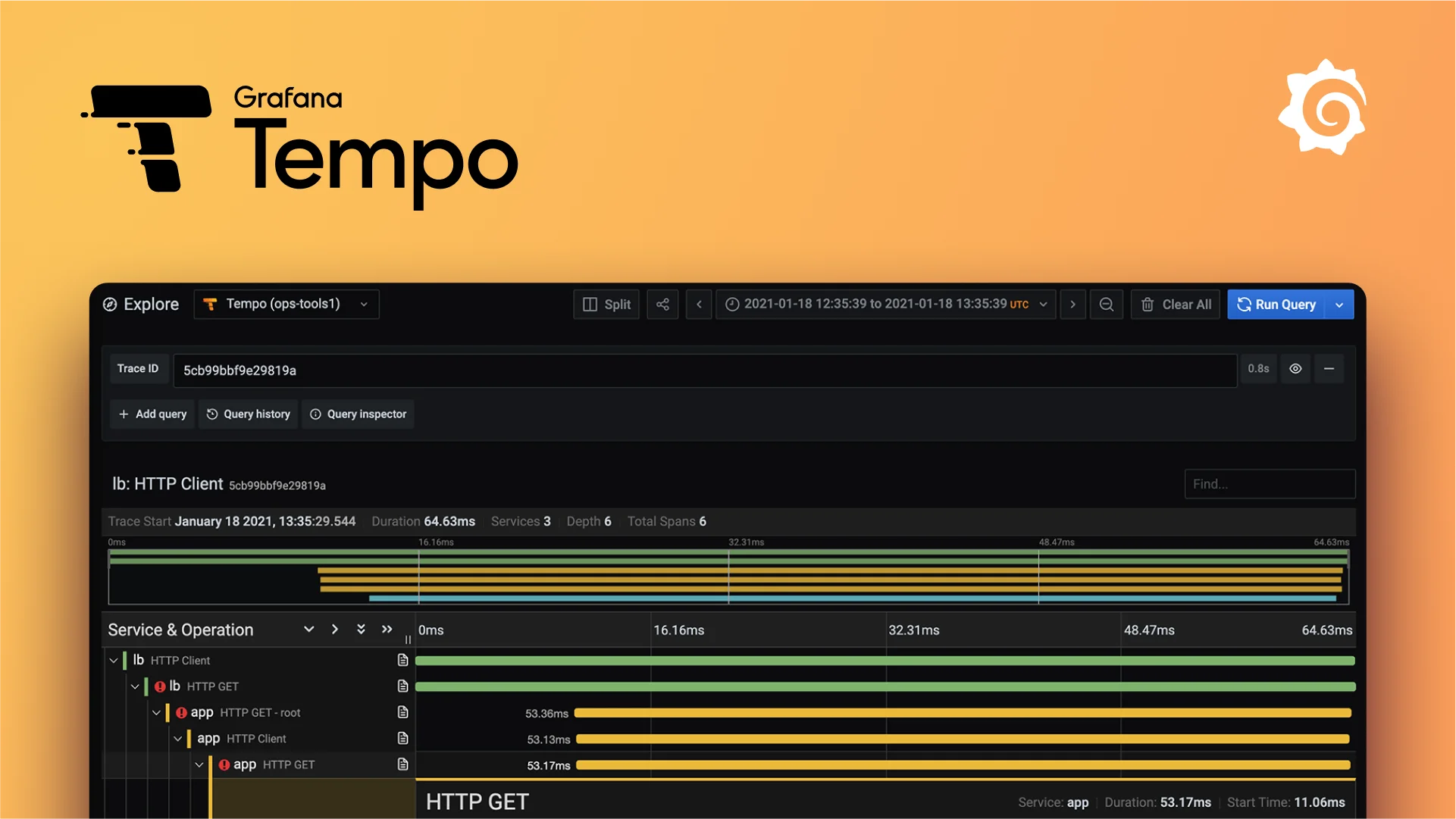
Grafana Tempo is a high-scale, open source distributed tracing backend created by Grafana Labs and released in October 2020, reaching general availability in June 2021 under the AGPLv3 license. It is purpose-built to solve the cost and complexity challenges of scaling distributed tracing in modern cloud-native environments. Unlike traditional tracing solutions that require heavyweight databases such as Elasticsearch or Cassandra, Tempo's only dependency is object storage (e.g., S3, GCS, Azure Blob), making it highly affordable for long-term trace retention at scale. By not indexing traces by default, Tempo allows teams to store orders of magnitude more trace data for the same cost. Tempo natively ingests traces from popular open source protocols — Jaeger, Zipkin, and OpenTelemetry — making it easy to adopt without re-instrumenting existing applications. It integrates deeply with Grafana for visualization, Prometheus for metrics correlation, and Loki for log correlation, enabling a fully composable observability stack. Grafana Tempo is ideal for DevOps and SRE teams, platform engineers, and cloud-native developers who need scalable, cost-conscious distributed tracing without the operational burden of managing complex databases. It is actively maintained by Grafana Labs and a growing open source community of 70+ contributors.
Key Features
- Object Storage Only: Requires no external database — only object storage (S3, GCS, Azure Blob) — dramatically reducing operational complexity and cost at scale.
- Multi-Protocol Trace Ingestion: Natively ingests traces from Jaeger, Zipkin, and OpenTelemetry, enabling adoption without re-instrumenting existing applications.
- Deep Grafana Ecosystem Integration: First-class integration with Grafana for visualization, Prometheus for metrics, and Loki for logs — forming a complete observability stack.
- Massive Scale at Low Cost: Avoids trace indexing to store orders of magnitude more trace data for the same cost as traditional tracing backends.
- Open Source with Enterprise Support: Released under AGPLv3 and actively maintained by Grafana Labs, with enterprise support and features available via Grafana Cloud.
Use Cases
- DevOps and SRE teams instrumenting microservices architectures to trace requests across distributed systems and diagnose latency issues.
- Platform engineering teams building a centralized observability stack by pairing Tempo with Grafana, Prometheus, and Loki for unified metrics, logs, and traces.
- Cost-conscious organizations replacing expensive Elasticsearch or Cassandra-backed tracing systems with an object-storage-based solution to reduce infrastructure spend.
- Cloud-native development teams using OpenTelemetry for application instrumentation who need a scalable backend to store and query trace data.
- Enterprises evaluating open source observability tooling who want vendor-neutral tracing with the option to migrate to Grafana Cloud for a fully managed experience.
Pros
- Extremely Cost-Effective: Using object storage as the only dependency eliminates the need for expensive database clusters, making large-scale tracing affordable.
- Easy to Operate: Minimal operational overhead compared to Elasticsearch or Cassandra-based tracing solutions, reducing the burden on SRE and platform teams.
- Broad Protocol Compatibility: Supports Jaeger, Zipkin, and OpenTelemetry out of the box, allowing teams to adopt Tempo without changing existing instrumentation.
- Thriving Open Source Community: Backed by Grafana Labs with 70+ contributors and thousands of active users, ensuring active development and long-term viability.
Cons
- Limited Querying Without Grafana: Tempo's query capabilities are most powerful when paired with Grafana; standalone query functionality is more limited compared to some competitors.
- Self-Hosted Complexity: While simpler than Elasticsearch-backed solutions, deploying and tuning Tempo in production still requires infrastructure expertise.
- No Built-In Indexing by Default: The no-index approach saves cost but can make ad-hoc trace search slower unless TraceQL or exemplars are leveraged via integrations.
Frequently Asked Questions
What is Grafana Tempo?
Grafana Tempo is an open source, high-scale distributed tracing backend created by Grafana Labs. It is designed to store and retrieve traces at massive scale using only object storage, without requiring a dedicated database.
What protocols does Grafana Tempo support?
Tempo supports Jaeger, Zipkin, and OpenTelemetry trace ingestion protocols, making it compatible with most existing instrumentation setups.
Is Grafana Tempo free to use?
Yes. Grafana Tempo is fully open source under the AGPLv3 license and free to self-host. Grafana Cloud also offers a managed Tempo experience with a free tier and paid plans for larger workloads.
How does Tempo differ from Jaeger or Zipkin?
While Jaeger and Zipkin are end-to-end tracing systems, Tempo is primarily a backend storage solution. It focuses on scalable, cost-efficient trace storage and retrieval, relying on Grafana for the visualization layer.
What storage backends does Grafana Tempo support?
Tempo supports any S3-compatible object storage, Google Cloud Storage (GCS), and Azure Blob Storage, as well as local disk for development and testing purposes.