
About
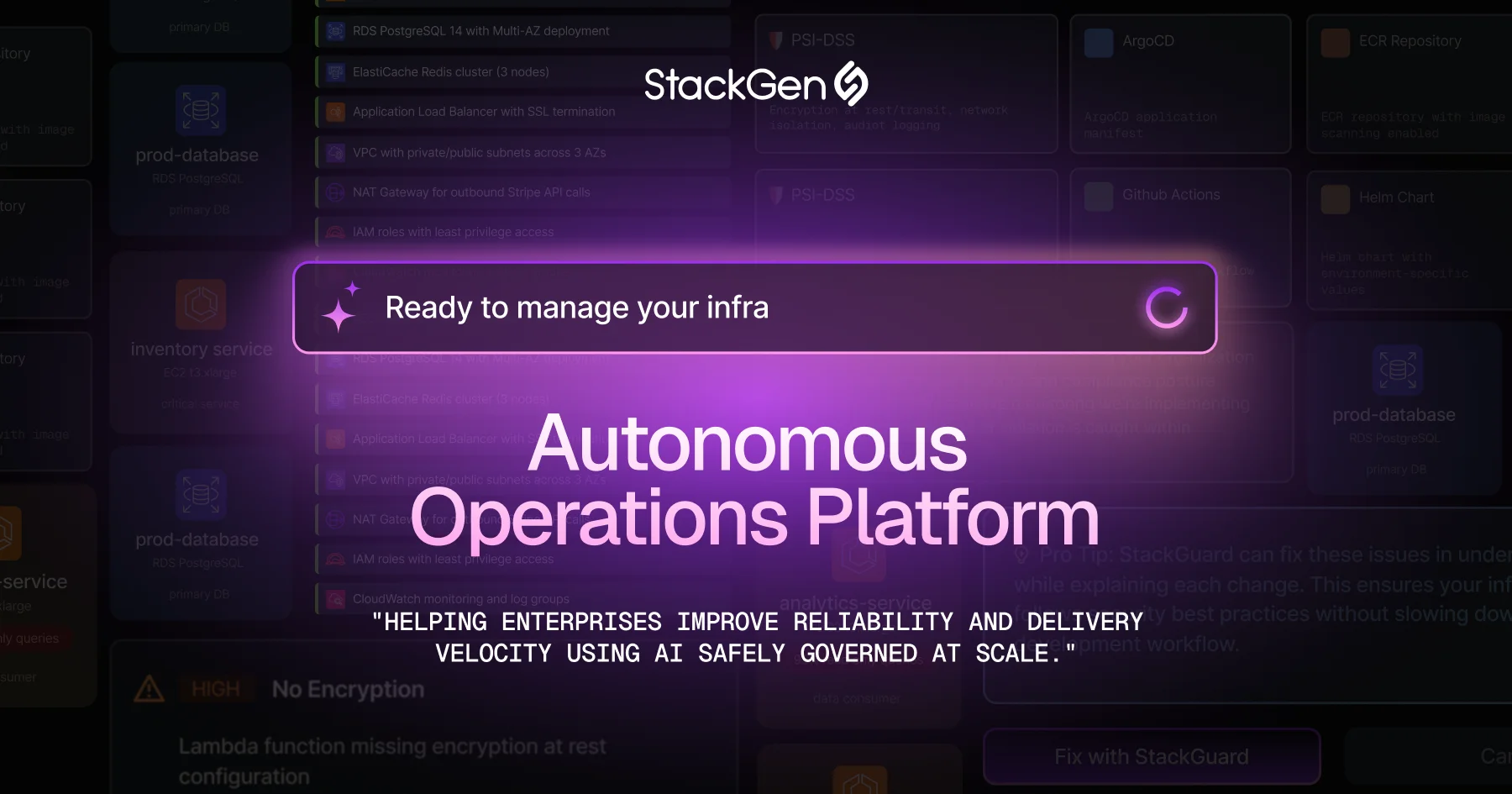
StackGen is an enterprise-grade autonomous operations platform built around Aiden, an agentic AI designed to take on the repetitive, time-consuming work that consumes the majority of ops teams' bandwidth. StackGen addresses three core engineering domains: Infrastructure (governance-first IaC management with compliance enforcement, drift management, and automated provisioning), DevOps (a generalist AI agent that automates daily workloads across existing stacks), and SRE (SLO-aware incident response with agentic, autonomous remediation). Key capabilities include a Visual Infracomposer for infrastructure design, custom module creation, pre-built skills and automated tasks for both IaC and SRE workflows, historical context awareness, and a knowledge base for intelligent decision-making. The platform features an MCP Server for IDE integration, bringing StackGen's power directly into developer workflows. StackGen also supports managed open-source observability, integrating with Grafana, Prometheus, and other ecosystem tools to provide systems dashboards, incident summaries, and action cards—transforming data overload into agentic composure. It is built for developers, DevOps engineers, SRE teams, platform engineers, and engineering leaders at organizations that need to scale operations without scaling headcount. Trusted by leading enterprises and recognized in four Gartner Hype Cycle reports in 2025, StackGen is designed to shift ops teams from doers to orchestrators.
Key Features
- Aiden Agentic AI: An autonomous AI agent that takes action across infrastructure, DevOps, and SRE workflows—not just recommending fixes, but executing them end-to-end.
- SLO-Aware Incident Response: Aiden monitors SLOs, correlates signals, and autonomously triages and remediates incidents before they impact reliability targets.
- Governance-First IaC Management: Enforces compliance policies, manages infrastructure drift, and automates Infrastructure as Code provisioning with built-in governance guardrails.
- Managed OSS Observability: Integrates with Grafana, Prometheus, and other open-source tools to deliver systems dashboards, incident summaries, and action cards with agentic composure.
- IDE Integration via MCP Server: Brings StackGen's autonomous capabilities directly into developer IDEs, enabling engineers to manage infrastructure and ops workflows without leaving their coding environment.
Use Cases
- Automating infrastructure provisioning and IaC lifecycle management with built-in compliance governance for enterprise cloud teams
- Enabling SRE teams to achieve SLO-aware incident triage and autonomous remediation, reducing mean time to resolution without manual intervention
- Streamlining platform engineering by creating governed golden paths that developers can self-serve without burdening ops teams
- Replacing manual observability toil with agentic dashboards, incident summaries, and action cards built on Grafana and Prometheus
- Shifting DevOps engineers from reactive operators to strategic orchestrators by automating repetitive daily workloads across existing toolchains
Pros
- Massive Toil Reduction: Reclaims up to 64% of ops teams' time by automating provisioning, compliance, incident triage, and observability tasks.
- Truly Agentic—Not Just Advisory: Aiden doesn't just surface insights; it autonomously executes remediation and management tasks across the full ops lifecycle.
- Multi-Role Coverage: Purpose-built workflows for DevOps engineers, SREs, platform engineers, and engineering leaders under a single unified platform.
- Deep Ecosystem Integration: Connects with existing DevOps toolchains including Grafana, Prometheus, and IDE environments, minimizing disruption to current workflows.
Cons
- Enterprise-Only Pricing: No self-service free tier or trial is available; access requires scheduling a sales demo, creating a barrier for smaller teams or individuals evaluating the platform.
- Onboarding Complexity: Integrating an autonomous ops agent across existing infrastructure and toolchains may require significant setup, configuration, and organizational change management.
- Limited Public Pricing Transparency: Cost information is not publicly disclosed, making it difficult to budget or compare without engaging the sales team.
Frequently Asked Questions
What is Aiden and what does it do?
Aiden is StackGen's agentic AI that autonomously handles DevOps, SRE, and infrastructure operations tasks—including provisioning, compliance enforcement, incident triage, drift management, and observability—so engineers can focus on higher-value work.
Who is StackGen designed for?
StackGen is built for DevOps engineers, SRE teams, platform engineers, developers, and engineering leaders at mid-to-large enterprises that need to scale operational efficiency without increasing headcount.
What tools does StackGen integrate with?
StackGen integrates with a wide DevOps ecosystem including Grafana, Prometheus, and developer IDEs via its MCP Server. It also supports custom integrations through its Integrations Overview feature.
How does StackGen handle compliance and governance?
StackGen enforces compliance policies directly within IaC workflows through its governance-first approach. It detects and remediates infrastructure drift, applies custom compliance modules, and ensures infrastructure changes meet policy requirements before deployment.
How do I get started with StackGen?
Getting started requires scheduling a demo through StackGen's website. The platform is enterprise-focused, so onboarding is guided by their team to fit your specific DevOps ecosystem and requirements.