

About
Torq is a next-generation AI SOC Platform built for enterprise security operations teams. It combines Agentic AI with Hyperautomation to radically accelerate every stage of the security operations lifecycle — from alert triage to incident response. At the core of the platform is an AI triage engine that de-duplicates events, filters false positives, and surfaces only genuine threats with crystal-clear verdicts and full audit logs. AI Agents can be deployed to autonomously investigate complex cases, chasing down evidence, building timelines, and recording recommended actions — all with full transparency for analyst oversight. Torq's response engine, powered by Socrates — a natural language-driven Agentic AI — enables autonomous or human-on-the-loop remediation of critical threats at machine speed. For proactive defense, Torq supports agentic threat hunting runbooks that cross-reference historical cases and recognize threat patterns. Case management capabilities allow security teams to automatically create, assign, and track incidents from a single source of truth, while built-in reporting tools keep stakeholders informed and strike teams coordinated. Torq integrates with hundreds of security tools and is purpose-built for enterprise SOCs, MSSPs, and MDRs looking to reduce mean time to respond, combat analyst burnout, and scale their security operations without proportionally scaling headcount.
Key Features
- Agentic Alert Triage: Automatically de-duplicates events, filters false positives, and prioritizes genuine threats with AI verdicts, transparent audit logs, and manual override options.
- AI Investigation Agents: Deploys specialized AI Agents to offload repetitive investigation tasks, gather evidence, build case timelines, and surface recommended actions — all fully transparent for analyst oversight.
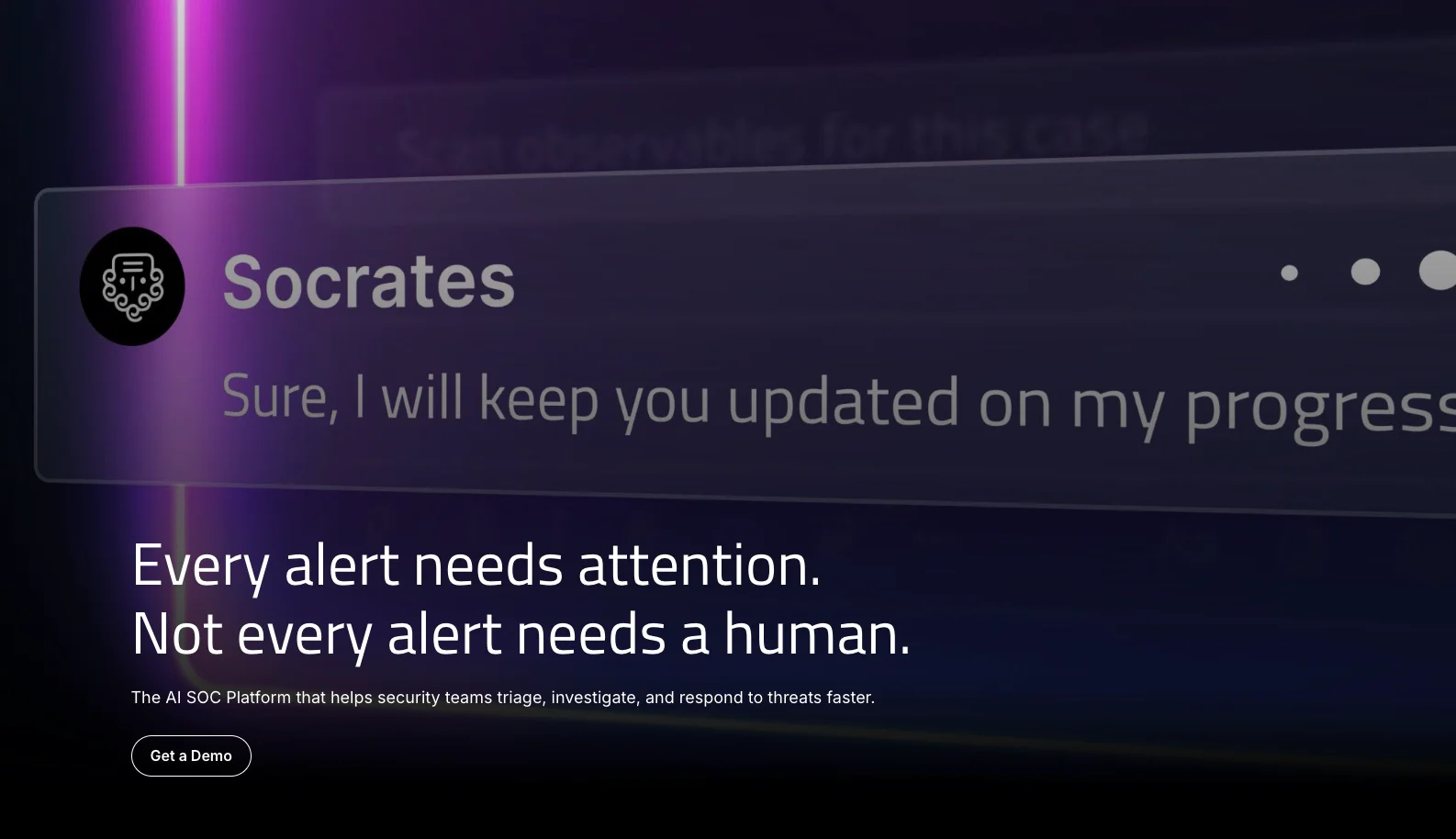
- Autonomous Threat Response (Socrates): Socrates, a natural language-driven Agentic AI, enables fully autonomous or human-on-the-loop remediation of critical threats at machine speed to stop contagion and remediate root cause.
- Intelligent Case Management: Automatically creates, assigns, and manages security cases from a single source of truth, keeping teams coordinated and communication clear throughout the incident lifecycle.
- Agentic Threat Hunting: Crafts agentic runbooks that access authorized data and tools, cross-references historical cases, recognizes threat patterns, and summarizes findings to uplevel both junior and senior analysts.
Use Cases
- Enterprise SOC teams using Torq to automatically triage thousands of daily alerts, suppress noise, and surface only verified threats for analyst review.
- MSSPs and MDRs deploying Torq to scale security operations across multiple client environments without increasing analyst headcount.
- Incident response teams leveraging Torq's AI agents to rapidly investigate and remediate phishing attacks, unauthorized access events, and cloud misconfigurations.
- Security engineers building agentic runbooks in Torq to automate threat hunting workflows that cross-reference historical cases and identify emerging attack patterns.
- SOC managers using Torq's case management and reporting capabilities to coordinate strike teams, track incident resolution, and report security posture to stakeholders.
Pros
- Dramatically reduces alert fatigue: AI-driven triage filters noise and false positives so human analysts can focus on verified, high-priority threats instead of drowning in unprocessed alerts.
- Machine-speed threat response: Agentic AI responds to threats at a speed and scale no human team can match, significantly slashing mean time to respond (MTTR) to critical incidents.
- Full transparency and human oversight: All AI agent actions are fully auditable, with human-on-the-loop controls and manual override options, giving teams confidence and regulatory defensibility.
- End-to-end SOC coverage: Covers the entire SecOps workflow — triage, case management, investigation, response, threat hunting, and reporting — in a single unified platform.
Cons
- Enterprise-focused pricing: Torq is designed for enterprise SOCs and MSSPs, making it likely cost-prohibitive for small teams or startups without a formal security operations function.
- Integration setup complexity: Maximizing Torq's value requires integrating with existing security tooling and data sources, which can involve significant initial configuration effort.
- Steep learning curve for agentic workflows: Building and tuning agentic runbooks and AI investigation workflows requires security expertise and ongoing refinement to optimize for specific environments.
Frequently Asked Questions
What is Torq?
Torq is an enterprise AI SOC (Security Operations Center) platform that combines Agentic AI and Hyperautomation to help security teams triage alerts, investigate incidents, and respond to threats faster and more efficiently.
What is Socrates in the Torq platform?
Socrates is Torq's natural language-driven Agentic AI that autonomously remediates critical threats. It can operate either fully autonomously or with a human-on-the-loop, enabling machine-speed response while maintaining analyst control.
Does Torq replace human security analysts?
No — Torq is designed to augment human analysts, not replace them. It handles repetitive, high-volume triage and investigation tasks so that human analysts can focus on complex, high-value work. All AI actions are transparent and include manual override options.
Who is Torq best suited for?
Torq is purpose-built for enterprise Security Operations Centers (SOCs), Managed Security Service Providers (MSSPs), and Managed Detection and Response (MDR) providers that need to scale threat response without proportionally scaling headcount.
What types of security use cases does Torq support?
Torq supports a wide range of SecOps use cases including SOC incident response, phishing response, threat enrichment, cloud misconfiguration detection, unauthorized access response, multi-cloud alert triage, and IT operations workflows like onboarding/offboarding and just-in-time access.